

Tolkien always said that stories should be told for their own sake; not as tracts written to advance the author's personal ethos. However, though fantasy is primarily a means of escapism, it can, in a secondary way, reveal something to the reader about the real world and himself.
The mechanics of this revelatory process are best illustrated by an observation that's often made about Star Trek. What Gene Roddenberry really had in mind for all those actors with plastic spoons stapled to their heads wasn't to make them aliens, but representatives of different aspects of human nature. The fantastical sci-fi context was a sub-creation that allowed the audience to suspend our disbelief so we could enjoy an entertaining story and hopefully learn something at the same time.
That being said, truly distinct fantasy worlds are extremely rare, if they exist at all. The reason is simple: every author lives in the real world and must draw upon it as a primary source. The result is that every fantasy and sci-fi setting contains elements of our primary world that are juxtaposed, exaggerated, or tweaked until a new sub-creation emerges.
The sub-creation process admits of varying degrees. At the near end you have something like urban fiction, wherein fantastic events take place in a near-photo realistic version of our world that is only different in that fantastic events take place there. Hellblazer form DC/Vertigo is the best example of this setting I can think of. At the far end we find cosmologies so bizarre that they bear hardly any resemblance to the known world. Some of the alien worlds imagined by H. P. Lovecraft fit this bill. Occupying the middle rung of the fantasy world continuum are settings that fundamentally resemble the actual past. Robert E. Howard's Conan cycle takes the literal approach, placing the barbarian king's adventures in a forgotten past age. Most mainstream fantasy settings simply approximate an idealized version of the middle ages. Examples are too numerous to name.
Whatever the degree of departure from reality, the author's primary focus should be to fashion a sub-creation different enough from the primary world to make the reader leave his mundane concerns behind while not straying so far as to disable suspension of disbelief. This delicate balance can be upset in the opposite way, whereby a supposed fantasy world contains so many allusions to primary world concepts, institutions, and historical events as to be jarring to the reader.
An author's primary weapon against these dangers is a solid foundation of thorough research. "Write what you know" has never been so apt. Borrowing popularly-known iconography and historical memes for a dash of verisimilitude is all well and good, but a writer should take care before uncritically swallowing fragments of the popular zeitgeist. The glut of pseudo-Arthurian tropes drawn from Bugs Bunny rather than Malory or White can get tedious; second only to the ubiquitous old black legend chestnut of the highly-organized, officially-sponsored zealots who go about strangling suspected demoniacs and generally ramming their superstitions down simple folks' throats. (Constructive advice for medieval fantasy authors: please consult histories on the Crusades and the Spanish Inquisition that weren't written as colonialist propaganda).
In conclusion, fantasy as a storytelling device works by rearranging the real world until the audience forgets where they are, allowing the author to weave a tale that primarily entertains while granting a fresh perspective on the human condition.
Wednesday, May 18, 2011

Monday, May 16, 2011
Inside Publishing
Desiring to get published myself, I've decided to do some research on the business side of the industry. Historically, writers have tended to perceive their relationship with publishers as an us vs. them proposition. This perception is partially true. Writers want to be paid the best royalty possible, and publishers want to keep overhead as low as possible.
The uniting factor between both sides is, ideally, a love of literature. When searching for someone to publish his manuscript, an author should seek out a publishing house that is aware of its station as a keeper of and influence on culture. Publishing is not a very profitable business. Projected margins can be as low as four percent for a successful publisher. Therefore, if your publishing house isn't in it for the love of the game, seriously reconsider doing business with them.
The same principle holds true for writers. It's a bit redundant to say, but technology has greatly transformed the business world in the last few years. Ebook sales, though still only around ten percent of the market, have doubled each year since hitting the mainstream. Add to that figure the fact that overall readership is steadily shrinking, and print media is apt to become even less profitable and more competitive than ever before. The short fiction magazine market has essentially become a field of authors writing for and reading each other. Books could potentially go the same way.
The upshot is, if you're a professional fiction writer, keep your day job.
The uniting factor between both sides is, ideally, a love of literature. When searching for someone to publish his manuscript, an author should seek out a publishing house that is aware of its station as a keeper of and influence on culture. Publishing is not a very profitable business. Projected margins can be as low as four percent for a successful publisher. Therefore, if your publishing house isn't in it for the love of the game, seriously reconsider doing business with them.
The same principle holds true for writers. It's a bit redundant to say, but technology has greatly transformed the business world in the last few years. Ebook sales, though still only around ten percent of the market, have doubled each year since hitting the mainstream. Add to that figure the fact that overall readership is steadily shrinking, and print media is apt to become even less profitable and more competitive than ever before. The short fiction magazine market has essentially become a field of authors writing for and reading each other. Books could potentially go the same way.
The upshot is, if you're a professional fiction writer, keep your day job.
Friday, May 13, 2011
Nethereal
Ten years in development
Five months in the writing
three drafts
780 pages
227,000 words
The final manuscript of my sci-fi/fantasy novel Netheral is finished.
Thanks to all who continue to offer their support.
Nick Enlowe
JJ Sauram
Josh E
Ben
Jeff
Kris
Lee
Mick
Paul
Ian
Wes
Sid
AMDG
Five months in the writing
three drafts
780 pages
227,000 words
The final manuscript of my sci-fi/fantasy novel Netheral is finished.
Thanks to all who continue to offer their support.
Nick Enlowe
JJ Sauram
Josh E
Ben
Jeff
Kris
Lee
Mick
Paul
Ian
Wes
Sid
AMDG
Tuesday, May 10, 2011
David Lynch
As an aspiring screenwriter, I've made a point of following the work of filmmakers who've mastered their craft. One of the directors I most like to keep an eye on is David Lynch. Sure, a lot of his stuff is weird for the sake of weird, but he's undeniably good at characterization.
I'd actually avoided Twin Peaks, even though it's probably what the mainstream knows him best for. I finally set aside some time to watch it and was surprised at how accessible it is.
For your enjoyment, here is my favorite parody of any thing of all time.
http://www.kylemaclachlan.com/viewer.php?id=4
I'd actually avoided Twin Peaks, even though it's probably what the mainstream knows him best for. I finally set aside some time to watch it and was surprised at how accessible it is.
For your enjoyment, here is my favorite parody of any thing of all time.
http://www.kylemaclachlan.com/viewer.php?id=4
Saturday, May 7, 2011
Manuscript Preparation Addendum
In light of a few oversights that were kindly pointed out to me regarding my first post on manuscript drafting and formatting, I present the following clarifications.
First, a disclaimer I should have included before: everything I post on this site, unless accompanied by a citation of the original source, is a product of my preference and limited experience. Since I haven't actually published anything yet, please consult other, more experienced authorities before applying any of my writing advice to your own work.
The specific point I'd like to address is my omission of the ironclad rule stating that one should always check a publication's in-house submission guidelines before submitting a manuscript. The publisher's formatting preferences automatically trump anything I suggest.
A note on my use of the Courier 10 pitch font for all manuscripts: after doing some research, I found out that the main reason this font became so popular is because it turns your word processor into a pretend typewriter. Also, Courier is a monotype font having a uniform width, making it easy to read and determine reliable word counts. A couple of people I know, and at least one professional author, have expressed their own (and their editors') distaste for Courier 10 pitch. Far be it from me to gainsay their superior wisdom. In fact, if I have bad luck with Courier, I'll gladly switch to Times New Roman for ease of use if nothing else.
Thanks for all the feedback, everyone.
As a final note, my screenwriting efforts have taught me that Hollywood is much less lenient on manuscript format than book publishers are. Novice screenwriters are advised to adhere slavishly to established guidelines, lest their scripts be discarded unread.
These rules don't seem to apply to Quentin Tarantino.


First, a disclaimer I should have included before: everything I post on this site, unless accompanied by a citation of the original source, is a product of my preference and limited experience. Since I haven't actually published anything yet, please consult other, more experienced authorities before applying any of my writing advice to your own work.
The specific point I'd like to address is my omission of the ironclad rule stating that one should always check a publication's in-house submission guidelines before submitting a manuscript. The publisher's formatting preferences automatically trump anything I suggest.
A note on my use of the Courier 10 pitch font for all manuscripts: after doing some research, I found out that the main reason this font became so popular is because it turns your word processor into a pretend typewriter. Also, Courier is a monotype font having a uniform width, making it easy to read and determine reliable word counts. A couple of people I know, and at least one professional author, have expressed their own (and their editors') distaste for Courier 10 pitch. Far be it from me to gainsay their superior wisdom. In fact, if I have bad luck with Courier, I'll gladly switch to Times New Roman for ease of use if nothing else.
Thanks for all the feedback, everyone.
As a final note, my screenwriting efforts have taught me that Hollywood is much less lenient on manuscript format than book publishers are. Novice screenwriters are advised to adhere slavishly to established guidelines, lest their scripts be discarded unread.
These rules don't seem to apply to Quentin Tarantino.


Wednesday, May 4, 2011
Original Remake
A few months ago, my buddy Mick and I were having a phone conversation. He happened to be watching Catwoman at the time and remarked how he felt the film was sub par, to say the least. Discussing a Batman-related property jogged my memory of DC's plans to reboot that franchise shortly after Christopher Nolan's third Batman film is released. That item brought us to the subject of remakes in general.
Mick and I agreed that there's nothing inherently wrong with filming an updated version of an extant property. The problem is that Hollywood seems to have dispensed with all originality and creativity while endlessly rehashing ideas.
The two of us pooled our efforts to think of an existing movie that had had potential but failed to realize it for whatever reason. After kicking that particular peanut around for a while, we finally settled on the 1990 almost-classic Robot Jox.
The original movie had a lot going for it: tense Cold War intrigue, a script by veteran sci-fi author Joe Haldeman, and giant robot effects that hold up pretty well even today. The acknowledged reason for the film's lack of enduring success is the conflicting visions of Haldeman and director Stuart Gordon. of Reanimator fame. The writer wanted to make a hard science fiction movie accessible to kids, and the director wanted to make a kids' movie that would also appeal to adults. The end result was neither.
From there, Mick and I decided to take up the challenge of completing Haldeman and Gordon's failed opus. After countless hours of planning, exhaustive and largely unnecessary research, and weeks of writing, I am proud to announce that our script for a Robot Jox remake; aptly titled Robot Jocks, is well into its second draft.
Upon completion of the final screenplay, we hope to track down the current rights holder and pitch the script to them--out of a morbid desire to find out how they'll react, if nothing else.
Mick and I agreed that there's nothing inherently wrong with filming an updated version of an extant property. The problem is that Hollywood seems to have dispensed with all originality and creativity while endlessly rehashing ideas.
The two of us pooled our efforts to think of an existing movie that had had potential but failed to realize it for whatever reason. After kicking that particular peanut around for a while, we finally settled on the 1990 almost-classic Robot Jox.
The original movie had a lot going for it: tense Cold War intrigue, a script by veteran sci-fi author Joe Haldeman, and giant robot effects that hold up pretty well even today. The acknowledged reason for the film's lack of enduring success is the conflicting visions of Haldeman and director Stuart Gordon. of Reanimator fame. The writer wanted to make a hard science fiction movie accessible to kids, and the director wanted to make a kids' movie that would also appeal to adults. The end result was neither.
From there, Mick and I decided to take up the challenge of completing Haldeman and Gordon's failed opus. After countless hours of planning, exhaustive and largely unnecessary research, and weeks of writing, I am proud to announce that our script for a Robot Jox remake; aptly titled Robot Jocks, is well into its second draft.
Upon completion of the final screenplay, we hope to track down the current rights holder and pitch the script to them--out of a morbid desire to find out how they'll react, if nothing else.
Monday, May 2, 2011
Manuscript Preparation
Yesterday, Nick and I were working on preparing one of his short story manuscripts for submission to a fantasy magazine. The rules I learned from submitting my own story proved quite useful. I was reminded that unearthing the general submission guideliness required days of time and effort and involved consulting several sources. I've decided to summarize the manuscript format that I use here.
Cover Page

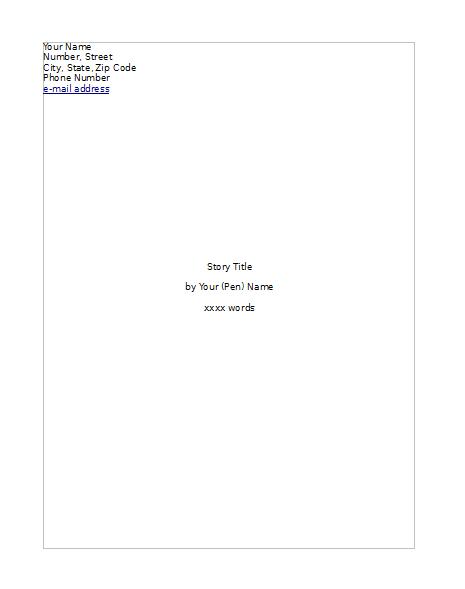
The margins should be one inch all around so the editor can make notes.
The author's contact information, including (real) name, mailing address, telephone number, and e-mail address goes in the upper left-hand corner and is single-spaced.
Halfway down the page, place the center-aligned title. One double-spaced line below that, write "by" and the author's real name or pen name, if applicable. Double-space again and list the manuscript's word count. I like to use "'x number' words" notation. Do not simply rely on your word processor's count. Editors have developed an industry standard method for tallying up the number of characters in a manuscript better suited to their needs.
The preferred word count formula is as follows: in your manuscript, locate an average-length, mid-paragraph line of text. Count all of the characters from left to right, even punctuation marks and spaces. Divide this figure by six. The product will give you the average number of characters per line. Next, count the total number of lines in the document. The main body of the text should always be double-spaced, so you don't have to count the empty spaces in between; just actual lines of text. A page with no breaks or other totally empty lines works best for conducting your count. Upon determining the total number of lines per page, multiply that figure by the average characters per line as derived earlier. Finally, multiply that number by the total number of pages (minus the cover page). Round this product to the nearest hundred. Authors round up. Editors round down.
In brief: word count = all the characters in a line/6 x total lines per page x (total pages - cover page), round to nearest hundred.
Once you've calculated and noted your manuscript's word count, your cover page is done.
First Page

Cover Page
The margins should be one inch all around so the editor can make notes.
The author's contact information, including (real) name, mailing address, telephone number, and e-mail address goes in the upper left-hand corner and is single-spaced.
Halfway down the page, place the center-aligned title. One double-spaced line below that, write "by" and the author's real name or pen name, if applicable. Double-space again and list the manuscript's word count. I like to use "'x number' words" notation. Do not simply rely on your word processor's count. Editors have developed an industry standard method for tallying up the number of characters in a manuscript better suited to their needs.
The preferred word count formula is as follows: in your manuscript, locate an average-length, mid-paragraph line of text. Count all of the characters from left to right, even punctuation marks and spaces. Divide this figure by six. The product will give you the average number of characters per line. Next, count the total number of lines in the document. The main body of the text should always be double-spaced, so you don't have to count the empty spaces in between; just actual lines of text. A page with no breaks or other totally empty lines works best for conducting your count. Upon determining the total number of lines per page, multiply that figure by the average characters per line as derived earlier. Finally, multiply that number by the total number of pages (minus the cover page). Round this product to the nearest hundred. Authors round up. Editors round down.
In brief: word count = all the characters in a line/6 x total lines per page x (total pages - cover page), round to nearest hundred.
Once you've calculated and noted your manuscript's word count, your cover page is done.
First Page

Now that you're on the actual first page, create a header to be displayed in the upper right. This header should appear on every subsequent page of the manuscript and should at least include the author's last name and the current page number, separated by a forward slash. The title (if it is short), or a significant element from the title, can also be placed between the author's name and the page number, also separated by slashes, e.g.: Farmer/Big Heist/1
For short stories, reproduce your contact information on the first page of the manuscript in the same format and position as it appears on the cover page.
Place the word count in the upper right-hand corner of the first page (not in the header).
Proceed halfway down the first page and write the story's title again. Double-space down and write "by" and the author's real/pen name.
Double space down twice, indent, and begin composing the story. Make sure the body of the text is double-spaced.
A vital detail often overlooked by first-time writers is the correct choice of font. Courier 10 pitch is the standard font for everything from novel manuscripts to screenplays. Your entire manuscript, including all of the information on the cover page, should appear in this font.
As an interesting aside, I use Open Office 3.3. Courier 10 pitch isn't listed in the drop down font menu, but Mick (not a typo; different guy) informed me that it can be written in manually. I tried this DIY tactic, and it worked.
Subscribe to:
Posts (Atom)

 Posts
Posts


